Message Us
 Call Us
 Can a Driver Who Was Eating While Driving Be Liable for a Crash?
By Anderson, Cummings & Drawhorn, LLP on October 11, 2022
By Anderson, Cummings & Drawhorn, LLP on October 11, 2022
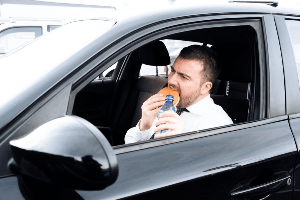
Drivers should operate their vehicles safely to avoid an accident. This includes avoiding distracted driving. Most people only think about cell phones as a form of distraction. But there are other behaviors that take a driver’s attention away from the road. For example, eating while driving.
Table of Contents
If a driver who was eating and driving crashes into your vehicle, he or she may be liable for your damages. Let our vehicle collision lawyers in Fort Worth review your claim. The consultation to discuss your legal options is free. There are also no upfront fees for our services.
Below, we discuss the dangers of eating while driving, including how the law determines liability if a crash occurs.
Eating behind the wheel increases the chances of causing a crash by 80 percent. This is according to the National Highway Traffic and Safety Administration (NHTSA). The same factors that make texting and driving dangerous also make eating and driving unsafe. These factors include:
Even one of these distractions on its own is dangerous. When combined with other inattentive behaviors, they can be lethal.
Drivers who are not watching the road may:
Proper steering is difficult with only one hand, especially during an emergency. For example, drivers may unexpectedly be forced to swerve to avoid a collision. Without both hands on the wheel, the driver may lose control of the vehicle and be unable to avoid crashing.
No, it is not illegal to eat while driving in Texas. However, doing so can still lead to legal consequences if it interferes with a driver’s ability to safely operate their vehicle. The Texas Transportation Code does not explicitly ban eating behind the wheel, but drivers can still be penalized if their inattention contributes to a traffic violation or crash.
Legally speaking, eating behind the wheel isn’t considered a violation by itself—but it can quickly become an issue if it leads to behavior that qualifies as distracted or reckless driving.
While Texas law doesn’t specifically prohibit eating while driving , law enforcement officers still have the discretion to issue a citation if the behavior leads to poor vehicle control or endangers others on the road.
From spilling coffee to unwrapping fast food or trying to eat while steering, even small distractions can slow your reaction time or affect your control of the vehicle. These actions might lead to a traffic violation—or worse, cause a serious crash that results in injuries or property damage.
According to the Texas Department of Insurance, eating while driving qualifies as a form of distracted driving , which is defined as any activity that diverts attention from driving. This includes not only texting or using electronic devices but also:
Any of these behaviors can pull a driver’s focus off the road, increasing the risk of a dangerous situation.
Drivers who are distracted by eating and violate traffic laws may face legal penalties. The Texas Department of Public Safety reports that distracted driving, regardless of its source, can result in citations or more severe repercussions if it causes an accident. Some of the possible consequences include:
When eating behind the wheel leads to behavior deemed dangerous, a driver could be charged with reckless driving. If eating interferes with a driver’s ability to maintain control—such as swerving, failing to yield, or running traffic signals—the behavior may be considered reckless.
Law enforcement officers may interpret such actions as endangering public safety, potentially resulting in a citation, fines, or more severe penalties such as license suspension. In some cases, repeat offenses or aggravating circumstances could lead to criminal charges or legal action by injured parties.
If a driver who was eating causes a car crash, they may be held liable for any resulting damages. Personal injury cases in Texas often hinge on negligence. Eating while driving could be used as evidence that the driver breached their duty of care, especially if it resulted in visible distraction or erratic behavior behind the wheel. In such situations, the distracted driver might be responsible for a range of losses, including:
Proving someone was eating before he or she caused a crash is often difficult. Especially if there was a passenger in the vehicle. The passenger may try to claim he or she was eating and not the driver.
However, there is some evidence you may be able to present to prove your claim. This includes:
You do not need to prove someone broke the law or was reckless to hold them liable for your damages.
Eating behind the wheel is a form of distracted driving and is therefore considered negligence. If you were injured by a driver who was distracted by food, you may be eligible to pursue compensation.
Our attorneys are prepared to investigate your claim and discuss your legal options. The legal consultation is free, and there are no upfront fees. There is no risk to speak to an attorney.
Call (817) 920-9000 to schedule your free consultation.

This page has been written, edited, and reviewed by a team of legal writers following our comprehensive guidelines. This page was approved by attorney Seth Anderson, whose team has more than 50 years of combined legal experience in helping victims of personal injury seek justice.

After a Fort Worth oilfield accident, you may be able to sue the contractor, the operator, or another company. Still, liability depends on who controlled the work, who created the dangerous condition, and whose conduct caused your injury. At Anderson, Cummings & Drawhorn, we know how complex oilfield accidents can...
Read Article
Grocery store slip and fall accidents are more serious than people think because they can cause serious injuries that may seem negligible at first. A sudden fall onto a hard floor can damage your head, spine, hips, joints, and other parts of your body, even when the fall initially looks...
Read Article
Multi-vehicle highway accidents in Fort Worth can cause serious injuries such as traumatic brain injuries, broken bones, spinal injuries, internal injuries, and severe soft tissue damage. You can be struck more than once as vehicles collide, increasing the force placed on the body. These crashes can occur on major highways...
Read ArticleTell us about your accident and your injuries. An injury lawyer from our team will call and provide you with a free evaluation of your case. If we can help, and you are unable to travel, we will come to your home, office, or hospital. It’s easy – let’s get started.

Email us anytime and we will get back to you.

Our attorneys will come to your home, office or hospital at your convenience.

Our team is ready and waiting to help you today.